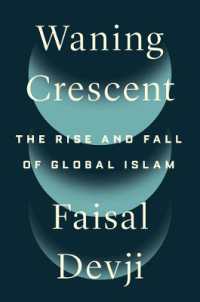
Waning Crescent : The Rise and Fall of Global Islam

49.05 SGD
会員価格
44.15
English

Singapore Main Store

Available

D04-05 Floor (, )
D04-06 Floor (, )

Product Description

A compelling examination of the rise of Islam as a global historical actor   Until the nineteenth century, Islam was variously understood as a set of beliefs and practices. But after Muslims began to see their faith as an historical actor on the world stage, they needed to narrate Islam’s birth anew as well as to imagine its possible death. Faisal Devji argues that this change, sparked by the crisis of Muslim sovereignty in the age of European empire, provided a way of thinking about agency in a global context: an Islam liberated from the authority of kings and clerics had the potential to represent the human race itself as a newly empirical reality.   Ordinary Muslims, now recognized as the privileged representatives of Islam, were freed from traditional forms of Islamic authority. However, their conception of Islam as an impersonal actor in history meant that it could not be defined in either religious or political terms. Its existence as a civilizational and later ideological subject also deprived figures like God and the Prophet of their theological subjectivities while robbing the Muslim community of its political agency. Devji illuminates this history and explores its ramifications for the contemporary Muslim world.


A compelling examination of the rise of Islam as a global historical actor
 
Until the nineteenth century, Islam was variously understood as a set of beliefs and practices. But after Muslims began to see their faith as an historical actor on the world stage, they needed to narrate Islam's birth anew as well as to imagine its possible death. Faisal Devji argues that this change, sparked by the crisis of Muslim sovereignty in the age of European empire, provided a way of thinking about agency in a global context: an Islam liberated from the authority of kings and clerics had the potential to represent the human race itself as a newly empirical reality.
 
Ordinary Muslims, now recognized as the privileged representatives of Islam, were freed from traditional forms of Islamic authority. However, their conception of Islam as an impersonal actor in history meant that it could not be defined in either religious or political terms. Its existence as a civilizational and later ideological subject also deprived figures like God and the Prophet of their theological subjectivities while robbing the Muslim community of its political agency. Devji illuminates this history and explores its ramifications for the contemporary Muslim world.
Available to Order

Usually dispatches within 3-5 business days

While every attempt has been made to ensure stock availability, occasionally we may run out of stock at our stores.

日本国内への配送は50.00SGD以上のご注文で無料

Discount is applied at checkout.

Recently Viewed Items

Related Products