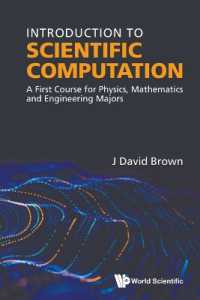
Introduction to Scientific Computation: A First Course for Physics, Mathematics and Engineering Majors

106.20 SGD
会員価格
95.58
English

Singapore Main Store

Not Available

F09-05 Floor (, )
F09-04 Floor (, )

Product Description

This book introduces scientific computation in an accessible and interactive way for undergraduates, especially those in the sciences, engineering, and mathematics. No prior programming experience is expected. Readers can begin directly from the introductory chapters, which cover basic elements of the Python programming language, then progress to the main chapters where techniques of scientific computation are presented and applied to specific problems. Examples and exercises are included in detail, covering diverse topics from various branches of science. These include cellular automata, the driven damped pendulum, Euler-Bernoulli beam theory, Newton's law of cooling, and many others.Rather than using established routines as a black box to memorize, this book delves into foundational concepts and encourages readers to apply fundamental principles to hands-on problems. Extensive use of scientific Python libraries and Jupyter Notebooks reinforce the student's understanding. This book is well-suited for a first exposure to scientific computation, but also to bridge introductory programming classes with advanced coursework in scientific modeling.


This book introduces scientific computation in an accessible and interactive way for undergraduates, especially those in the sciences, engineering, and mathematics. No prior programming experience is expected. Readers can begin directly from the introductory chapters, which cover basic elements of the Python programming language, then progress to the main chapters where techniques of scientific computation are presented and applied to specific problems. Examples and exercises are included in detail, covering diverse topics from various branches of science. These include cellular automata, the driven damped pendulum, Euler-Bernoulli beam theory, Newton's law of cooling, and many others.Rather than using established routines as a black box to memorize, this book delves into foundational concepts and encourages readers to apply fundamental principles to hands-on problems. Extensive use of scientific Python libraries and Jupyter Notebooks reinforce the student's understanding. This book is well-suited for a first exposure to scientific computation, but also to bridge introductory programming classes with advanced coursework in scientific modeling.
Unavailable

This product is currently out of stock. Please check back later.

Discount is applied at checkout.

Recently Viewed Items

Related Products