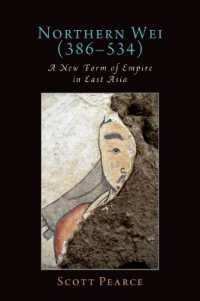
Northern Wei (386-534) : A New Form of Empire in East Asia (Oxford Studies in Early Empires)

160.97 SGD
Member Price
144.88
English

Singapore Main Store

Available

D16-02 Floor (, )
D19-02 Floor (, )

Product Description

Emerging from collapse of the Han empire, the founders of Northern Wei had come south from the grasslands of Inner Asia to conquer the rich farmlands of the Yellow River plains. Northern Wei was, in fact, the first of the so-called "conquest dynasties" complex states seen repeatedly in East Asian history in which Inner Asian peoples ruled parts of the Chinese world. An innovative contribution to East Asian and Chinese history of the medieval period, Northern Wei (386-534) combines received historical text and archaeological findings to examine the complex interactions between these originally distinct populations, and the way those interactions changed over time. Scott Pearce analyses traditions borrowed and adapted from the long-gone Han dynasty including government and taxation as well as the new cultural elements such as the use of armor for man and horse in the cavalry and the newly-invented stirrup. Further, this book discusses the fundamental change in the dynastic family, as empresses began to play an increasingly important role in the business of government. Though Northern Wei fell in the early sixth century, the nature of the state was thus fundamentally changed, in the Chinese world and East Asia as a whole; it had laid down a foundation from which a century later would emerge the world empire of Tang.


Emerging from collapse of the Han empire, the founders of Northern Wei had come south from the grasslands of Inner Asia to conquer the rich farmlands of the Yellow River plains. Northern Wei was, in fact, the first of the so-called "conquest dynasties" complex states seen repeatedly in East Asian history in which Inner Asian peoples ruled parts of the Chinese world.

An innovative contribution to East Asian and Chinese history of the medieval period, Northern Wei (386-534) combines received historical text and archaeological findings to examine the complex interactions between these originally distinct populations, and the way those interactions changed over time. Scott Pearce analyses traditions borrowed and adapted from the long-gone Han dynasty including government and taxation as well as the new cultural elements such as the use of armor for man and horse in the cavalry and the newly-invented stirrup. Further, this book discusses the fundamental change in the dynastic family, as empresses began to play an increasingly important role in the business of government. Though Northern Wei fell in the early sixth century, the nature of the state was thus fundamentally changed, in the Chinese world and East Asia as a whole; it had laid down a foundation from which a century later would emerge the world empire of Tang.
Available to Order

Usually dispatches within 3-5 business days

While every attempt has been made to ensure stock availability, occasionally we may run out of stock at our stores.

Free domestic shipping on orders over 50.00SGD

Discount is applied at checkout.

Recently Viewed Items

Related Products