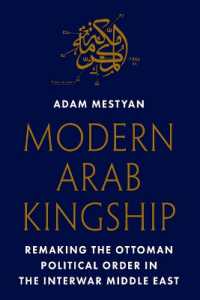
Modern Arab Kingship : Remaking the Ottoman Political Order in the Interwar Middle East

39.24 SGD
Member Price
35.32
English

Singapore Main Store

Available

D15-01 Floor (, )
D15-06 Floor (, )

Product Description

How the “recycling” of the Ottoman Empire’s uses of genealogy and religion created new political orders in the Middle East In this groundbreaking book, Adam Mestyan argues that post-Ottoman Arab political orders were not, as many historians believe, products of European colonialism but of the process of “recycling empire.” Mestyan shows that in the post–World War I Middle East, Allied Powers officials and ex-Ottoman patricians collaborated to remake imperial institutions, recycling earlier Ottoman uses of genealogy and religion in the creation of new polities, with the exception of colonized Palestine. These polities, he contends, should be understood not in terms of colonies and nation-states but as subordinated sovereign local states—localized regimes of religious, ethnic, and dynastic sources of imperial authority. Meanwhile, governance without sovereignty became the new form of Western domination. Drawing on previously unused Ottoman, French, Syrian, and Saudi archival sources, Mestyan explores ideas and practices of creating composite polities in the interwar Middle East and, in doing so, sheds light on local agency in the making of the forgotten Kingdom of the Hijaz, Jordan, Egypt, Saudi Arabia, and Syria, the first Muslim republic. Mestyan considers the adjustment of imperial Islam to a world without a Muslim empire, discussing the post-Ottoman Egyptian monarchy and the intertwined making of Saudi Arabia and the State of Syria in the 1920s and 1930s. Mestyan’s innovative analysis shows how an empire-based theory of the modern political order can help refine our understanding of political dynamics throughout the twentieth century and down to the turbulent present day.


How the "recycling" of the Ottoman Empire's uses of genealogy and religion created new political orders in the Middle East

In this groundbreaking book, Adam Mestyan argues that post-Ottoman Arab political orders were not, as many historians believe, products of European colonialism but of the process of "recycling empire." Mestyan shows that in the post-World War I Middle East, Allied Powers officials and ex-Ottoman patricians collaborated to remake imperial institutions, recycling earlier Ottoman uses of genealogy and religion in the creation of new polities, with the exception of colonized Palestine. These polities, he contends, should be understood not in terms of colonies and nation-states but as subordinated sovereign local states—localized regimes of religious, ethnic, and dynastic sources of imperial authority. Meanwhile, governance without sovereignty became the new form of Western domination.

Drawing on previously unused Ottoman, French, Syrian, and Saudi archival sources, Mestyan explores ideas and practices of creating composite polities in the interwar Middle East and, in doing so, sheds light on local agency in the making of the forgotten Kingdom of the Hijaz, Jordan, Egypt, Saudi Arabia, and Syria, the first Muslim republic. Mestyan considers the adjustment of imperial Islam to a world without a Muslim empire, discussing the post-Ottoman Egyptian monarchy and the intertwined making of Saudi Arabia and the State of Syria in the 1920s and 1930s.

Mestyan's innovative analysis shows how an empire-based theory of the modern political order can help refine our understanding of political dynamics throughout the twentieth century and down to the turbulent present day.
Available to Order

Usually dispatches within 3-5 business days

While every attempt has been made to ensure stock availability, occasionally we may run out of stock at our stores.

Free domestic shipping on orders over 50.00SGD

Discount is applied at checkout.

Recently Viewed Items

Related Products